
Swim tunnels & respirometry
Swim Tunnels & Respirometry Systems
Swim tunnels built for fish swimming studies and automated intermittent-flow respirometry. Choose a Standard system in nine sizes from 0.5 L to 100 L, or a fully customizable Alpha system — both run Ucrit, fatigue and metabolic-rate protocols in Aquafab Workbench.


Fish swimming studies
Swim tunnels built for swimming-performance research
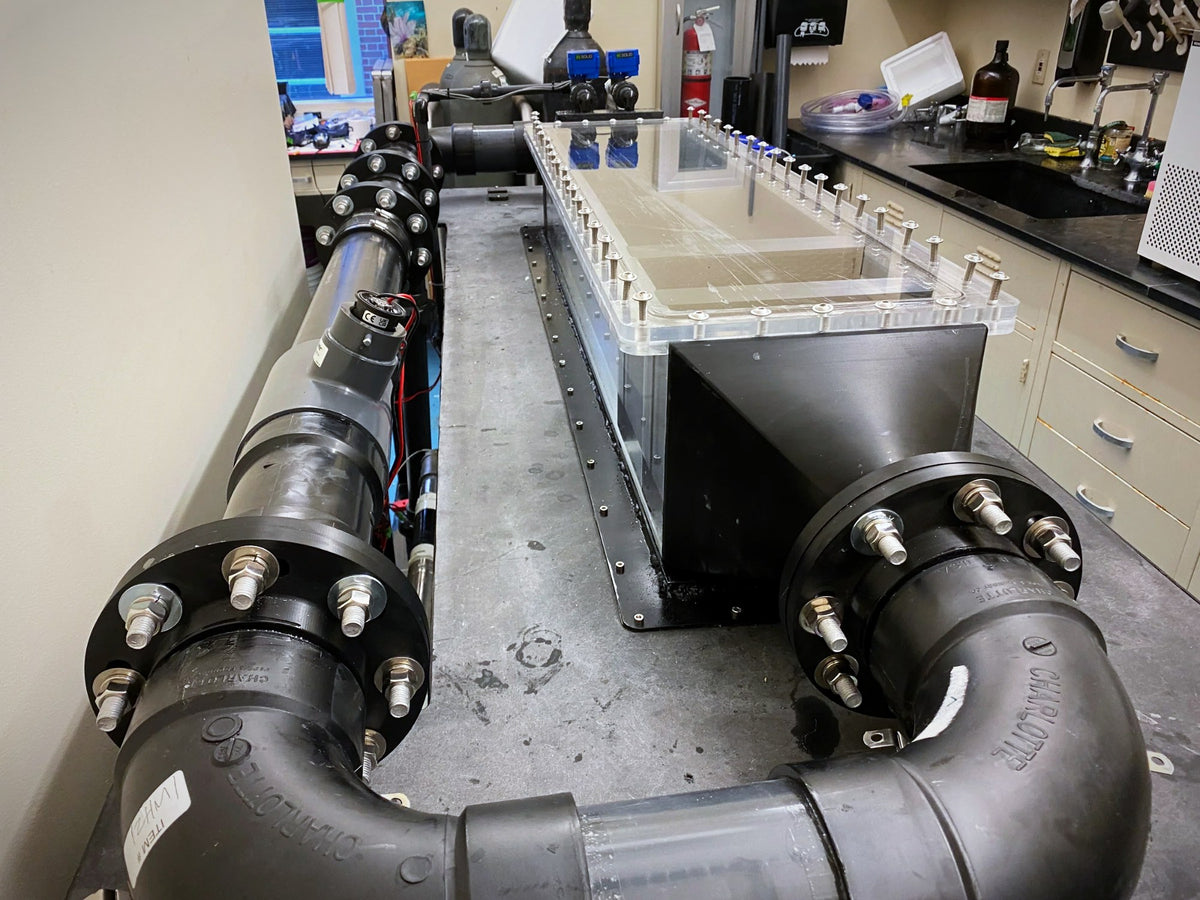
Every Aquafab respirometer is a swim tunnel first: a clear acrylic test section with conditioned, calibrated flow that a fish swims against while the software runs the protocol and records the result.
- Critical swimming speed (Ucrit) with automatic step-velocity protocols
- Full fatigue and endurance trials, timed and logged
- Oxygen consumption while swimming — active and maximum metabolic rate
- Clear on every side for filming kinematics and behavior
- Use it as a swim tunnel alone, or add respirometry whenever you need it
Swim studies
What you can run in an Aquafab swim tunnel
Critical swimming speed (Ucrit)
Step the current up at set intervals until the fish fatigues. The software runs the ramp and logs the speed and time.
Fatigue & endurance
Hold a fixed speed, or repeat bouts, and record time to fatigue and recovery for full swim-performance studies.
Swimming energetics
Measure oxygen use at each speed for cost of transport, active metabolic rate and aerobic scope.
Kinematics & behavior
High-clarity acrylic lets you film from the sides and above for tail-beat, gait and station-holding analysis.
Performance across temperature
Add thermal control to run the same swim protocol at different temperatures or through a thermal ramp.
Flow you can trust
Flow straighteners and guided calibration — or PIV flow calibration — so the speed you set is the speed the fish swims.
Two product lines
Alpha or Standard — pick your starting point
Every Aquafab respirometer runs automated intermittent-flow trials in Aquafab Workbench. The difference is how much of the system is built around you.

Our no-limits swim tunnel and respirometry platform. Test-section size, flow up to 500 cm/s, rapid thermal cycling, multiple chambers, sensors and materials are engineered around your animals and protocol.
- Custom dimensions, 2 in to 72+ in
- Thermal cycling 0–50 °C at up to 5 °C/min
- Operator console and integrated control cabinet

Proven swim tunnels in fixed volumes — faster to quote and build, with the same software, flushing and calibration.
- 0.5, 1, 1.5, 3, 5, 10, 20, 50 or 100 L
- Integrated flush pump and flow calibration
- Optional thermal control and sensor packages
Side by side
How Alpha and Standard compare
| Compare | Standard | Alpha |
|---|---|---|
| Chamber size | Nine volumes, 0.5 L to 100 L | Any size — 2 in to 72+ in, cross-sections to 36 × 36 in |
| Flow | Sized to each standard tunnel | Up to 500 cm/s, pumps sized to your target velocity |
| Thermal | Ambient, set-point or cycling options | 0–50 °C with rapid cycling up to 5 °C/min |
| Layout | Single swim tunnel | Single or multi-chamber, custom plumbing and reservoirs |
| Software | Aquafab Workbench — every feature | Aquafab Workbench — every feature |
| Best for | Most fish and invertebrate studies, teaching labs, fast lead times | Large or unusual animals, demanding thermal or flow protocols, core facilities |

Respirometry, explained
Measure metabolism by measuring oxygen
A respirometer seals an organism in a chamber of known volume and records how quickly it uses oxygen — the most direct way to measure metabolic rate in aquatic animals.
In intermittent-flow respirometry, the tunnel alternates between a sealed measurement period and a flush with fresh, oxygenated water, so trials can run for hours or days without the animal becoming stressed.
- Swimming adds controlled flow for active metabolic rate
- Resting and standard metabolic rate with the flow turned down
- Temperature and oxygen control for stress and climate studies
Applications
What researchers use swim tunnels and respirometers for
Swimming performance
Ucrit, fatigue, endurance and cost of transport in fish and other swimmers.
Thermal tolerance
Metabolic response to warming, cooling and rapid tidal temperature swings.
Hypoxia & water quality
Oxygen limits and recovery under controlled low-oxygen conditions.
Ecotoxicology
Sub-lethal effects of pollutants and stressors on metabolism.
Growth & aquaculture
Energy budgets and feeding studies for farmed and wild species.
Teaching physiology
Classic metabolic-rate labs with standard oxygen sensors.
How to choose
Choosing the right swim tunnel
Match the tunnel to the fish
A common guideline keeps the fish's cross-section under about 10% of the test section, with length for several body lengths. We help you size it.
Standard or Alpha?
Standard sizes fit most animals from larval fish to large adults. Choose Alpha for custom dimensions, higher flows, multi-chamber layouts or rapid thermal cycling.
Temperature protocol
Stable set-point, or programmable cycling from 0–50 °C at up to 5 °C/min.
Automation level
Guided runs for teaching labs, or fully automated measure/flush cycles for multi-day trials.
Powered by Aquafab Workbench
Swim trials and respirometry, fully automated.
Aquafab Workbench runs the velocity protocol, measure/flush cycle and thermal program for you — day and night — and records it all.
Ucrit & fatigue protocols
Ucrit step tests, fatigue and endurance trials with automatic velocity ramps and logged results.
Measure / flush automation
Valve and pump control for sealed measurement and flush periods on your schedule.
Thermal cycling
Run respirometry under programmed temperature ramps and cycles alongside flushing.
Calibrated & logged
Guided calibration for flow, temperature and flush volume, with time-stamped logs of every cycle.
FAQ
Swim tunnel & respirometry questions
Can I use the system only as a swim tunnel, without respirometry?
Yes. You can run pure swimming-performance work — Ucrit, fatigue and endurance — with no oxygen measurement. The same tunnel does respirometry whenever you need it.
What size swim tunnel do I need?
It depends on the size of your fish. Tell us the species and body length and we'll recommend a Standard size from 0.5 L to 100 L, or a custom Alpha build if nothing fits.
Which oxygen sensors do your systems use?
Our systems are designed to work with standard research oxygen sensors, and we can integrate the meters your lab already owns. Tell us what you use when you configure.
Can one system run several chambers?
Yes. Multi-chamber configurations can be run and synchronized from Aquafab Workbench. Describe your setup in the builder.
Don't see exactly what you need?
We'll build it.
Most of our systems start as a conversation. Describe your experiment and we'll design around it.