

Teaching Flow Chamber
Teaching Flow Chamber
Plug-and-play acrylic flume for classroom demonstrations and undergraduate labs, in three standard sizes.
A durable, compact and fully transparent flow chamber that lets students observe and control real fluid dynamics. Available in three standard sizes with standard or advanced flow, optional temperature control, sensors, velocity measurement and lighting — all run from Aquafab Control over USB or Bluetooth.
Designed, fabricated and tested in Cincinnati, Ohio
Runs on Aquafab Workbench — programming, calibration and data logging built in
Lifetime technical support, plus optional installation and training
System builder
Configure your system
Pick a size, flow range and thermal option, then add sensors, velocity measurement and lighting. Classroom bundles and multi-unit discounts are available — mention your class size in the notes.
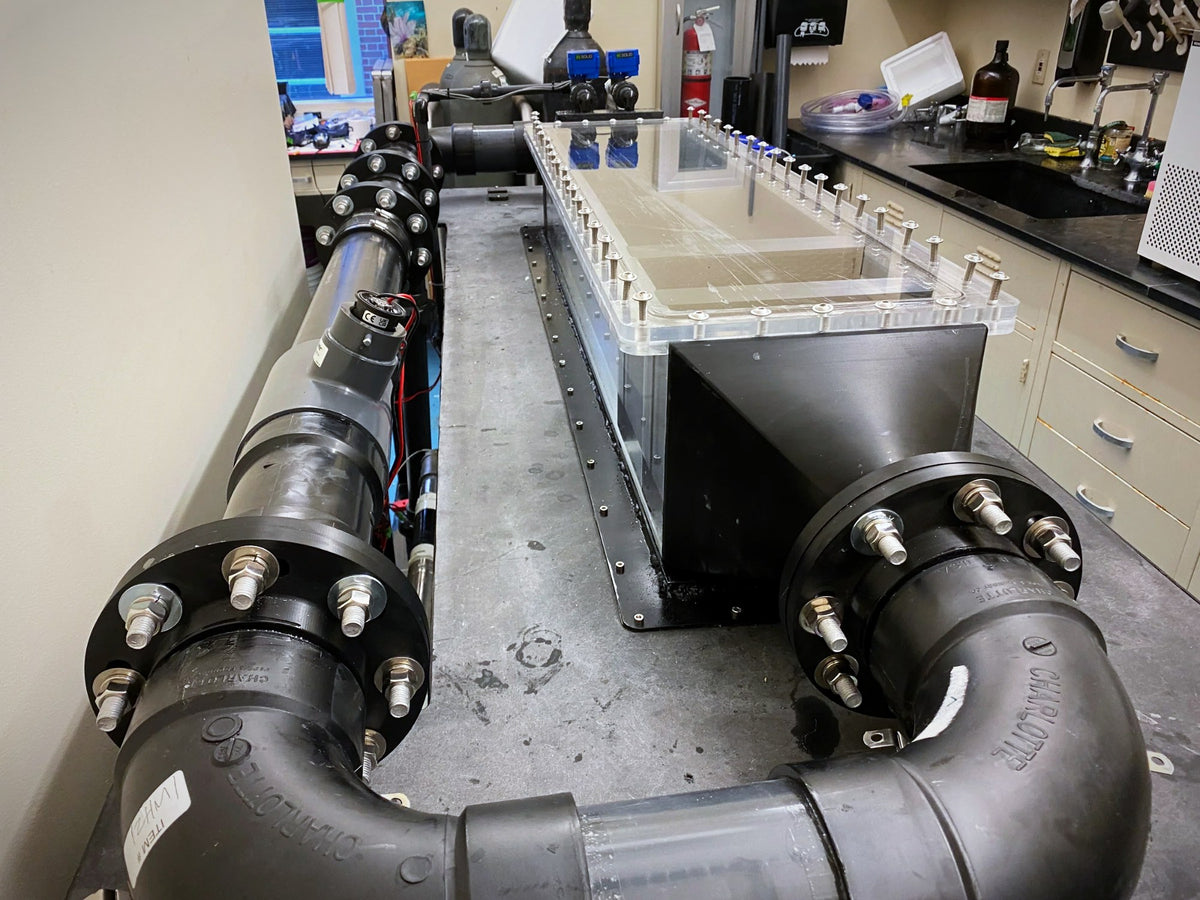
The Teaching Flow Chamber brings real hydrodynamics into the classroom. Compact, durable and fully transparent, it lets students watch laminar and turbulent flow, boundary layers and organism–flow interactions happen in front of them — and control the experiment themselves from a laptop over USB or Bluetooth with Aquafab Workbench.
Designed for teaching labs
- Plug-and-play — set up and tear down within a lab period.
- High-clarity acrylic for 360° observation by the whole class.
- Integrated honeycomb flow straighteners for stable, laminar flow.
- Variable-speed pump control to demonstrate a range of velocity profiles.
- Optional dye-injection ports for flow visualization.
Three standard sizes
Choose a 50 × 50 × 300 mm (2 × 2 × 12 in) benchtop unit for demonstrations, a 100 × 100 × 500 mm (4 × 4 × 20 in) chamber for small-group labs, or a 150 × 150 × 500 mm chamber when students need room for organisms or models.
Grows with your curriculum
Start with standard 0–50 cm/s flow, or choose the advanced 0–300+ cm/s pump for boundary-layer studies and upper-division labs. Add built-in 10–50 °C temperature control to demonstrate tidal cycles and environmental shifts, a sensor suite for water-quality labs, velocity measurement for quantitative exercises, and lighting for plants, algae or corals.
Typical lab exercises
- Laminar vs. turbulent flow and Reynolds number
- Boundary layers and drag on models
- Organism behavior and station-holding in current
- Temperature effects on physiology
| Standard sizes | |
| Small | 50 × 50 × 300 mm (2 × 2 × 12 in) |
| Medium | 100 × 100 × 500 mm (4 × 4 × 20 in) |
| Large | 150 × 150 × 500 mm |
| Flow | |
| Standard | 0–50 cm/s |
| Advanced | 0–300+ cm/s |
| Flow conditioning | Integrated honeycomb straighteners |
| Visualization | Optional dye-injection ports |
| Environment | |
| Thermal — basic | Ambient, with monitoring and inlet/outlet ports for an external chiller or heater |
| Thermal — advanced | Built-in 10–50 °C control |
| Control | |
| Software | Aquafab Control |
| Connection | USB or Bluetooth |
Specifications describe standard builds. Every Aquafab system can be adapted — ask us about dimensions, materials or performance outside these ranges.
| Option | Choice | What it means |
|---|---|---|
| Test-section size | 50 × 50 × 300 mm | 2 × 2 × 12 in benchtop unit — ideal for demonstrations. |
| 100 × 100 × 500 mm | 4 × 4 × 20 in — the most popular size for small-group labs. | |
| 150 × 150 × 500 mm | Largest standard chamber, with room for organisms or models. | |
| Flow range | Standard 0–50 cm/s | Reliable, precise flow for general demonstrations and basic experiments. |
| Advanced 0–300+ cm/s | High-velocity capability for boundary-layer studies and advanced labs. | |
| Thermal control | Ambient | Temperature monitoring plus inlet/outlet ports for an external temperature controller. |
| Built-in 10–50 °C | Integrated control for tidal-cycle and environmental-shift demonstrations. | |
| Sensor integration | None | |
| Standard | Temperature, pH and DO for foundational experiments. | |
| Advanced | Adds ORP, turbidity and conductivity for detailed water-quality studies. | |
| Custom | Pick individual sensors from the full list. | |
| Choose your sensors | Dissolved oxygen | Optical DO for respirometry and hypoxia work. |
| Temperature | ||
| pH | ||
| Conductivity / salinity | ||
| ORP | Oxidation-reduction potential. | |
| Turbidity | ||
| Ammonia | NH₃/NH₄⁺ monitoring for husbandry. | |
| Nitrate | ||
| Chlorophyll-a / fluorescence | Algal and phytoplankton studies. | |
| Light (PAR) | Photosynthetically active radiation. | |
| Pressure / depth | Water level and depth logging. | |
| Flow velocity | In-line or in-channel velocity sensing. | |
| Other — tell us in the notes | ||
| Velocity measurement | None | |
| Basic | Turbine/paddlewheel sensor providing flow data for student analysis. | |
| Lighting | None | |
| Freshwater | Warm white with programmable sunrise/sunset. | |
| Plants + Algae | Full-spectrum white with red and violet accents. | |
| Coral + Reef | 12-channel full-spectrum reef lighting. | |
| Extras | Dye-injection ports | For flow-visualization exercises. |
| Lesson-plan package | Ready-to-run lab exercises and instructor notes. |
- Introductory and upper-division fluid dynamics labs
- Biology and marine science courses studying organisms in flow
- Engineering outreach and demonstrations
- K–12 STEM programs and science fairs
Every Aquafab system is backed by the people who designed and built it.
- Warranty: standard systems include a 2-year warranty on Aquafab-fabricated components and electronics.
- Lifetime support: phone, email and remote support for as long as you own the system.
- Installation & training: optional on-site installation, commissioning and hands-on training for your lab or teaching staff.
- Maintenance: on-site maintenance visits and replacement parts on request.
Questions?
Talk it through with an engineer.
Not sure which options fit your protocol? We're happy to help you specify the right system — no obligation.